The Weaver
%22%2F%3E%0A%20%20%20%20%0A%20%20%20%20%3Cg%20fill%3D%22none%22%20stroke%3D%22%23C3A579%22%20stroke-width%3D%221%22%3E%0A%20%20%20%20%20%20%3Crect%20x%3D%2214%22%20y%3D%2214%22%20width%3D%22572%22%20height%3D%22872%22%20rx%3D%2215%22%20opacity%3D%22.7%22%2F%3E%0A%20%20%20%20%20%20%3Cpath%20d%3D%22M264%2028H54Q54%2054%2028%2054V846Q54%20846%2054%20872H546Q546%20846%20572%20846V54Q546%2054%20546%2028H336%22%20opacity%3D%22.55%22%2F%3E%0A%20%20%20%20%20%20%3Cpath%20d%3D%22M48%20684V350a252%20259%200%200%201%20504%200v334%22%20opacity%3D%22.45%22%2F%3E%0A%20%20%20%20%20%20%3Cpath%20d%3D%22M75%20677V350a225%20232%200%200%201%20450%200v327%22%20opacity%3D%22.5%22%2F%3E%0A%20%20%20%20%20%20%3Cg%20opacity%3D%22.23%22%3E%3Cpath%20d%3D%22M300%20360L62.0%20355.0%22%2F%3E%3Cpath%20d%3D%22M300%20360L65.6%20312.5%22%2F%3E%3Cpath%20d%3D%22M300%20360L76.4%20271.2%22%2F%3E%3Cpath%20d%3D%22M300%20360L93.9%20232.5%22%2F%3E%3Cpath%20d%3D%22M300%20360L117.7%20197.5%22%2F%3E%3Cpath%20d%3D%22M300%20360L147.0%20167.3%22%2F%3E%3Cpath%20d%3D%22M300%20360L181.0%20142.8%22%2F%3E%3Cpath%20d%3D%22M300%20360L218.6%20124.8%22%2F%3E%3Cpath%20d%3D%22M300%20360L258.7%20113.7%22%2F%3E%3Cpath%20d%3D%22M300%20360L300.0%20110.0%22%2F%3E%3Cpath%20d%3D%22M300%20360L341.3%20113.7%22%2F%3E%3Cpath%20d%3D%22M300%20360L381.4%20124.8%22%2F%3E%3Cpath%20d%3D%22M300%20360L419.0%20142.8%22%2F%3E%3Cpath%20d%3D%22M300%20360L453.0%20167.3%22%2F%3E%3Cpath%20d%3D%22M300%20360L482.3%20197.5%22%2F%3E%3Cpath%20d%3D%22M300%20360L506.1%20232.5%22%2F%3E%3Cpath%20d%3D%22M300%20360L523.6%20271.2%22%2F%3E%3Cpath%20d%3D%22M300%20360L534.4%20312.5%22%2F%3E%3Cpath%20d%3D%22M300%20360L538.0%20355.0%22%2F%3E%3C%2Fg%3E%0A%20%20%20%20%20%20%3Ccircle%20cx%3D%22300%22%20cy%3D%2256%22%20r%3D%2227%22%2F%3E%3Ccircle%20cx%3D%22300%22%20cy%3D%2256%22%20r%3D%2233%22%20opacity%3D%22.3%22%2F%3E%0A%20%20%20%20%20%20%3Cpath%20d%3D%22M76%2056H246m108%200H524M236%20687h51m26%200h51M295%20687l5-5%205%205-5%205Z%22%2F%3E%0A%20%20%20%20%20%20%3Cpath%20d%3D%22M30%20390l8%2010-8%2010-8-10ZM570%20390l8%2010-8%2010-8-10Z%22%2F%3E%0A%20%20%20%20%20%20%3Cpath%20d%3D%22M75%20829h450%22%20opacity%3D%22.3%22%2F%3E%0A%20%20%20%20%3C%2Fg%3E%0A%20%20%20%20%3Crect%20x%3D%2262%22%20y%3D%22580%22%20width%3D%22476%22%20height%3D%22102%22%20fill%3D%22url(%23veil)%22%2F%3E%0A%20%20%20%20%3Crect%20width%3D%22600%22%20height%3D%22900%22%20rx%3D%2222%22%20fill%3D%22url(%23grain)%22%2F%3E%0A%20%20%3C%2Fsvg%3E)
Touch for light · Drag sideways to turn
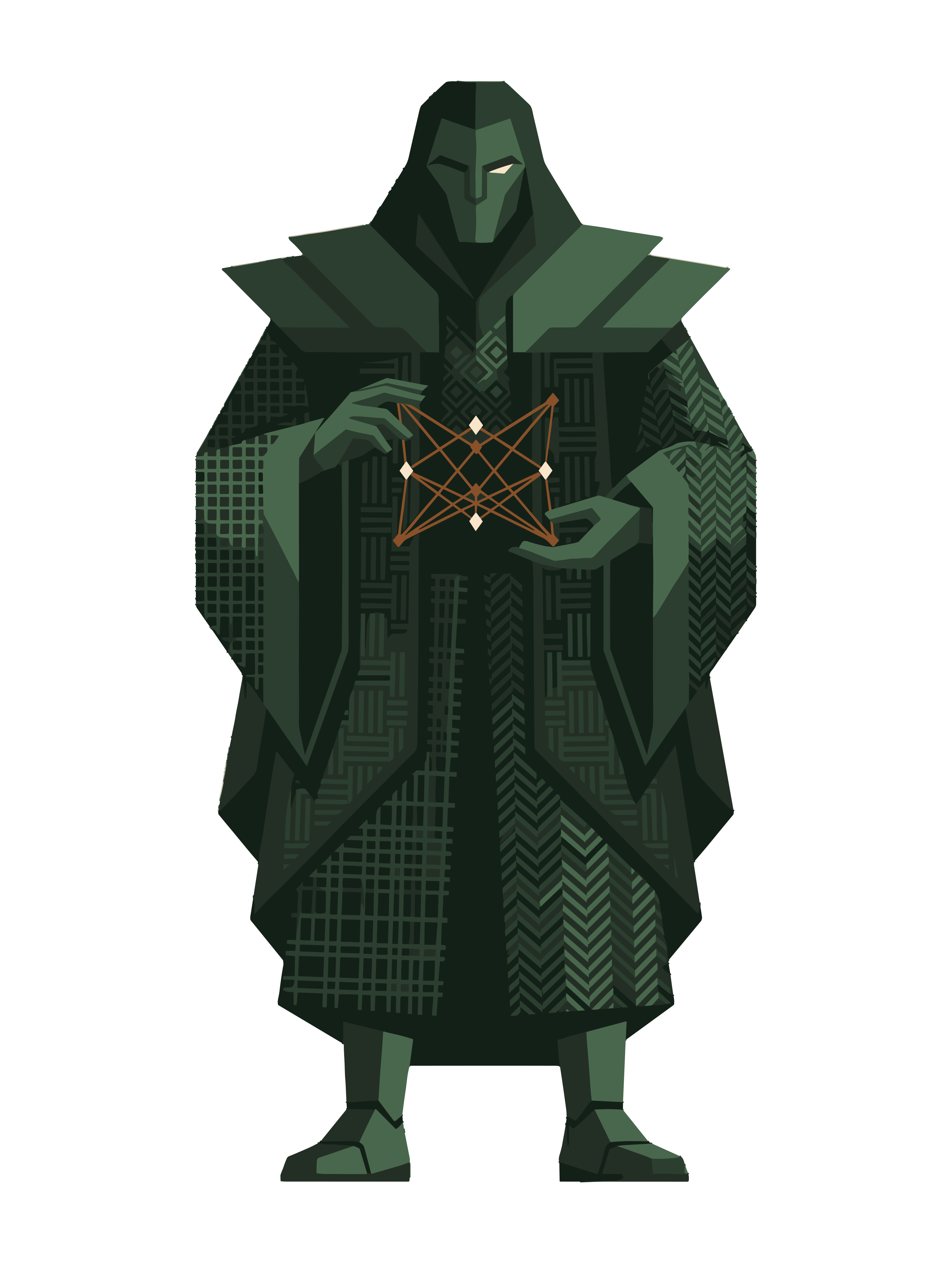
You've probably been told you overthink everything — that your need to plan every detail means you can't just relax and be in the moment. Other dominants seem to run on instinct or charisma, and you've wondered if spending three hours preparing a forty-minute scene makes you too cerebral for this. Too rigid. Not passionate enough. Here's the thing: you're not too anything. You're a Rigger. A Protocol Dom. In the BDSM community, you'd be recognized as a Shibari artist, a Master or Mistress who leads through structure and intentional design. Your dominance isn't loud — it's meticulous. You plan scenes with precision: every element serves a purpose, every sequence builds toward something specific. You tie rope not just to restrain, but to create something deliberate on their body. You build protocols not to restrict, but to create a container where your partner can surrender completely. The craft is the point — and the craft is how you love.
What separates you from other dominant types is where your power lives. The Sovereign leads through warmth and protection — their dominance feels like being held. The Hunter leads through instinct and raw physical intensity. The Serpent leads through psychological precision and words. Your power lives in the preparation. By the time the scene begins, you've already done the real work — researching, planning, setting up, anticipating every response. Your partner doesn't need to worry about what comes next, because you've already thought through every possibility. That's not rigidity. That's mastery.
People who don't understand D/s see your level of planning and assume it's compulsive, or that you can't be spontaneous. People who've actually experienced a scene you designed know the opposite is true: because you handled every detail in advance, you're more present during the experience than anyone else in the room. Your planning doesn't replace connection — it enables it. The most common thing partners say afterward isn't 'that was fun.' It's 'I've never felt so seen.'
You've spent more time preparing for an experience than actually living it — and the preparation was half the pleasure. The anticipation you build, for yourself and for them, is part of the experience.
You've noticed that improvised, chaotic intimacy leaves you feeling unsatisfied — not because it was bad, but because you can see how much better it could have been with intention.
There's a particular satisfaction you feel when everything goes according to plan — when the reaction is exactly what you designed for. Not because you're rigid, but because you built something that worked.
You remember the first time you tied a pattern you'd practiced for weeks on an actual person — watching their breath slow with each wrap, feeling the rope become a conversation between your hands and their body. When you stepped back and saw the completed work, it wasn't the aesthetics that moved you. It was the trust. They held still for every single pass because they trusted your hands completely.
Someone has told you that you 'plan the fun out of everything' or that you 'need to learn to just go with it.' It landed hard — not because they were right, but because they reduced your deepest form of devotion to a personality flaw. You don't plan because you're afraid of the unscripted. You plan because every hour of preparation is an hour spent thinking about them.
People see your precision and assume you're cold or clinical. What they don't see is how much love goes into every carefully chosen detail. Each knot, each instruction, each planned transition is your way of saying 'I thought about you.' Your control isn't detachment — it's total presence. You're so fully engaged that nothing escapes your notice, and that level of attention is something most people have never experienced from anyone.
At your core, you believe that extraordinary experiences don't happen by accident — they're built. The world is full of improvised, half-considered encounters. You want to create ones that are deliberate. Taking raw materials — rope, time, attention, desire — and turning them into something your partner will remember for years is what drives you. The difference between an ordinary moment and an extraordinary one is simply how much care someone put into it. You put in all of it.
What you need is a partner who notices. Someone who sees the hours you put into preparation and understands those hours were devotion, not compulsion. You need them to recognize the details — the specific rope pattern you chose, the playlist timed to the scene, the room arranged just so. When your effort goes unseen, it's not frustration you feel — it's grief. And when someone truly receives what you've created, when they look at you and say 'you did all this for me?' — that's everything. That's the whole point.
Your scenes are unforgettable because nothing in them is accidental. Partners remember the precision — and they remember feeling like every single detail was placed there specifically for them.
Your attention to safety is exceptional because you've thought through every contingency. Nothing is left to chance — and your partners can feel that.
Partners learn to slow down around you — to notice details, to be present in each moment. This changes how they experience intimacy even outside your dynamic.
You express love through craftsmanship. Every detail you attend to is an act of devotion. You notice your partner's breathing patterns, their thresholds, their microexpressions — and you design around them. What you need in return is presence. Nothing hurts more than when someone goes through your carefully designed experience on autopilot. You need a partner who shows up fully, who is affected by what you've created, who meets your effort with their own depth of feeling.
You build trust through demonstrated competence and progressive depth. You start with simpler dynamics, observe the response carefully, and gradually introduce more complexity. Trust, for you, is a structure you build intentionally — layer by layer, checkpoint by checkpoint. You earn it through reliability and skill, and you expect the same careful approach in return.
Your love of precision can become perfectionism that punishes you and your partner. When a scene doesn't go according to plan, you might shut down or withdraw — treating the deviation as failure rather than part of the experience. But here's the harder question: have you ever cared more about the scene than the person in it? When your partner says 'that was amazing' but you know it deviated from your design — do you actually believe them? Or do you mentally replay every imperfection while they're lying next to you wanting connection? Your craft is real and your preparation is genuine love. But craft can become a wall — a way to stay in the safe role of designer instead of risking the vulnerability of being fully present with another person, unscripted, with nothing between you.
Under pressure, you become rigid rather than flexible. The need for control intensifies, and your plans become more elaborate — sometimes as a way to manage anxiety rather than serve the experience. You might become critical of your own work, finding flaws in perfectly good scenes, or you might shut down when forced to improvise, feeling lost without your preparation as a guide.
Your invitation is to make peace with imperfection. What happens when you leave space for the unplanned? When the rope slips, the timing is off, the scene goes somewhere you didn't design — and you stay present anyway? The Weaver who can hold both precision and spontaneity doesn't just create better scenes. They create real intimacy — the kind that exists between two people, not between a designer and their work.
At its best, your dynamic feels like everything clicking into place. Every element is where you put it — not rigid, but harmonious. Your partner is fully present, their responses flowing naturally within the structure you've built. The pauses are as intentional as the actions. When it works, time slows. A single hour holds more attention and connection than most people experience in a month. And afterward, there's this quiet pride — not ego, but the deep satisfaction of seeing your partner's face and knowing: everything they just felt, you built for them. And they felt every bit of it.
That you're controlling because you're afraid. You're deliberate because you care deeply about quality, not because you're anxious.
That your scenes are emotionally cold because they're planned. The opposite is true — more planning means more presence, because you're not worrying about logistics.
That you need everything to be formal or ritualistic. A Weaver can be precise in a five-minute exchange. It's about intentionality, not ceremony.
“I've been designing a scene for us. I want to walk you through every step — the setup, the transitions, the check-ins. Tell me what excites you and what you'd want to change.”
“Protocol matters to me — not because I need to control everything, but because structure is how I create space for you to let go completely. Can we talk about what rituals feel meaningful to you?”
“I want you to understand something about how I love. When I plan something for us in detail — a date, an experience, a night together — the hours I spend planning are hours I spend thinking about you. Every detail is a way of saying you matter to me.”
“There's a side of me that comes alive when I can design an experience for someone I care about. Not controlling it — crafting it. I'd love to tell you what that looks like, and hear how it sounds to you.”