The Fawn
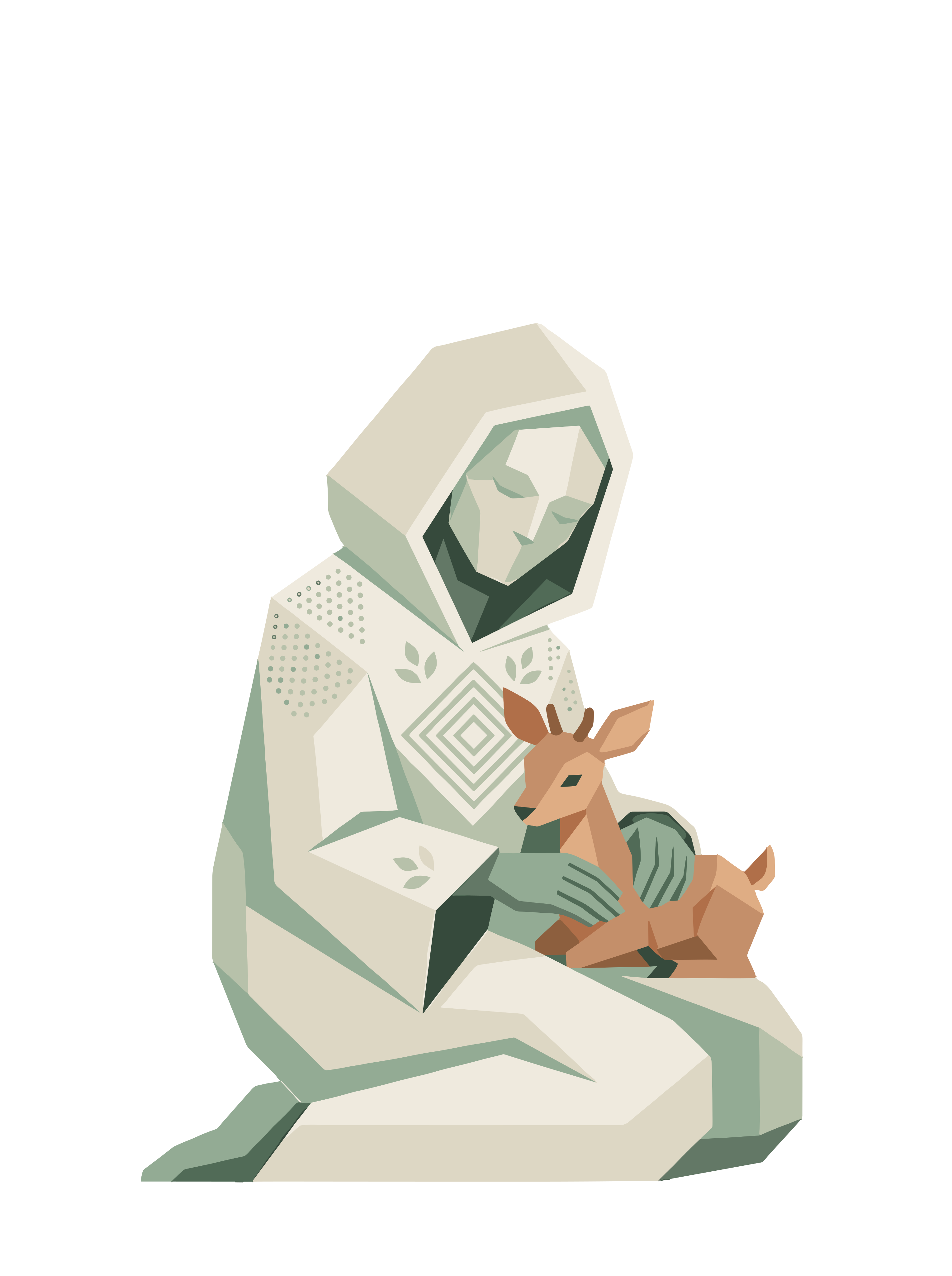
You've probably worried that wanting to be held this much makes you immature. Weak. Too needy for any adult relationship. You've watched other submissives who thrive on pain, or deep service, or bratty resistance, and wondered: does wanting to curl up and be small and cared for even count? Here's the truth — it counts. And it has a name. You're a Little. A Pet. In the BDSM community, you'd be recognized as a Baby Girl or Baby Boy, a Soft Sub — someone whose submission is expressed through vulnerability, tenderness, and the profound act of letting yourself be small with someone who makes that safe. You don't submit to be controlled. You submit to be held. And being held — truly, completely held — is one of the most powerful experiences a human being can have.
What sets you apart from other submissive types is what you're seeking in surrender. The Devotee submits through service and devotion — their surrender is about giving. The Ember submits to intensity — their surrender is about transcendence through being pushed. The Trickster submits through playful resistance — their surrender has to be won. Your surrender is about receiving. You let go so that you can finally, fully, let someone take care of you — without apology, without performing strength, without the constant low-level exhaustion of holding yourself together for a world that never lets you rest.
People who don't understand D/s see your softness and assume fragility. They see you wanting pet names, gentle guidance, a lap to curl into, and they project weakness onto it. They don't understand why a competent adult would want to feel small on purpose. Anyone who's actually held you knows the truth: choosing vulnerability in a world that punishes it takes more courage than most displays of toughness. And the people who get to see your full softness — your littlespace, your unguarded need, the way you melt when you feel truly safe — those people know they're witnessing something rare. Your softness isn't the absence of spine. It's what spine looks like when it has nothing left to prove.
You've curled into someone's arms and felt your whole nervous system exhale — not because you were anxious, but because safety, for you, isn't just comforting. It's transcendent.
Someone called you 'needy' once, and it stung — not because it was wrong, exactly, but because they said it like it was something to fix rather than something to honor.
You've had moments of being held, spoken to softly, or gently guided, and felt tears come — not from sadness, but from the profound relief of being allowed to just be small.
You remember the first time you let yourself fully drop into littlespace or petspace with someone you trusted. The world got quiet. Your adult worries — the deadlines, the decisions, the constant performance of having it together — all of it dissolved. You were just soft, and small, and held. And when they called you 'good girl' or 'good boy' in that low, steady voice, something in your chest unlocked that you didn't even know was clenched.
Someone has told you to 'grow up' or asked 'aren't you a bit old for this?' — and it landed like a slap. Not because they shamed you into doubting yourself, but because they reduced the bravest thing you do — letting yourself be fully vulnerable with another person — into something childish. You don't seek softness because you can't handle the hard world. You seek it because you handle the hard world all day, every day, and you need one place where you can finally put it down.
People see your softness and assume they know everything. They might underestimate your complexity, or treat your vulnerability as an invitation to handle you carelessly. What they miss is the iron underneath. You've chosen softness in a world that punishes it. That choice is remade every single day, and it requires a spine of steel. Your tenderness is not the absence of strength — it's what strength looks like when it has nothing to prove.
You're driven by a deep need for genuine safety — not the intellectual concept of safety, but the felt, embodied experience of it. In a world that demands you perform competence and independence at all times, you ache for a space where those masks come off. Your submission isn't about giving up power. It's about finding the one place where you don't have to pretend you have everything under control.
You need someone who is strong enough that your softness doesn't scare them. Someone who won't mistake your vulnerability for fragility, or your need for closeness as a burden. You need a partner who actively delights in caring for you — not from obligation, but from a genuine, deep-seated desire to protect and nurture. You need to feel chosen, not just tolerated. The difference between 'I can handle your needs' and 'I love your needs' is everything to you.
In your presence, even the most guarded people start to soften. Your openness shows them it's safe to let their walls down — and for many of your partners, you're the first person who ever made tenderness feel possible.
You read emotional states with extraordinary accuracy. You know when someone needs closeness before they ask, and you respond to the unspoken with a fluency that makes your partners feel deeply understood.
You prove that needing to be held is not weakness — it's one of the most universal human experiences, and your willingness to claim it openly gives others the courage to claim their own needs too.
You love through closeness — physical proximity, emotional openness, the thousand small gestures of affection that say 'I'm here, I'm yours.' You reach for your partner's hand instinctively. You curl into them in sleep. Your love is expressed in the way your body seeks theirs. What you need is active care. Not just tolerance of your softness, but enthusiasm for it. You need to hear 'I've got you' and feel it in the way they hold you — firmly, gently, as if you're precious.
You trust through feeling. Your body knows before your mind does whether someone is safe. You track tone of voice, quality of touch, the difference between perfunctory affection and genuine tenderness. Trust builds slowly, in small moments of being held well — and it can shatter in a single moment of carelessness.
Your need for safety can make you stay in dynamics that have stopped being nourishing. Because vulnerability requires trust, and trust is hard-won, you might hold on to a partner who no longer deserves your softness simply because starting over feels impossible. You might also suppress your own needs — ironically — to avoid being 'too much,' performing an easy, low-maintenance version of yourself that protects others from the full depth of what you need. But here's the harder question: have you ever used your softness to avoid growing up? When being the 'little one' means you never have to make hard decisions, never have to be responsible for someone else's feelings, never have to face the parts of adult life that scare you — is that still vulnerability, or is it a hiding place? Look at your pattern: do you consistently choose partners who are happy to keep you small? If every dynamic you've ever been in positions you as the one who receives and never the one who holds — sit with whether that's genuine need or a way to avoid discovering what you're capable of when no one is there to catch you.
When stressed, you might become clingy in ways that push partners away, creating the very abandonment you're trying to prevent. Or you might go the opposite direction — withdrawing, performing independence, pretending you don't need what you desperately need. At your most stressed, you might accept care that's rough or inadequate, convincing yourself that any holding is better than none.
Your invitation is to learn to hold yourself — not as a replacement for being held by others, but as a foundation. Can you be your own safe harbor while also letting others dock there? The Fawn who has cultivated self-tenderness doesn't need to be rescued. They choose to be held, and that choice — free and strong and clear — transforms vulnerability from need into gift.
At its best, your dynamic feels like being wrapped in something warm after being cold for too long. Your partner's arms are certain, their voice is low and steady, and for the first time today — maybe the first time in longer than that — you don't have to hold yourself up. You can just land. Be small. Be soft. Be exactly the amount of needy that you actually are, without editing. And they're not just tolerating it — they're drinking it in. Your softness feeds something in them just as their strength feeds something in you. It's not a transaction. It's an ecosystem.
That you need to 'toughen up' or 'grow out of it.' Your softness is not a developmental stage — it's a fully realized way of being.
That you're the same as a Devotee. You're not seeking purpose through service — you're seeking safety through tenderness. Different needs, different expression.
That your vulnerability makes you a pushover. You can be soft and still have fierce boundaries about who gets access to that softness.
“I want to talk about what caregiver and little dynamics mean to me. When I go into that soft, small headspace — littlespace, petspace, whatever we want to call it — I need you to understand: that's not me being less than myself. That's me being more myself than anywhere else. I want to know if holding that space for me is something that lights you up, or just something you'd accommodate.”
“Aftercare isn't a nice-to-have for me — it's where the whole experience lives. Being held after a scene, hearing your voice, feeling your hands in my hair while I come back — that's not the epilogue. That's the point. Can we talk about what aftercare looks like for both of us?”
“I need more tenderness than most people expect, and I want to be honest about that with you. It's not a flaw — it's how I'm built. When you hold me, something in me settles in a way nothing else can reach. I need to know if that's something you want to give, not just something you can tolerate.”
“There's a side of me that needs to be taken care of — not because I can't function alone, but because being soft with someone is where I feel most connected and most alive. It might look unusual from the outside, but it's the most real thing about me. I'd like to share what that looks like, and hear how it sounds to you.”