The Mirror
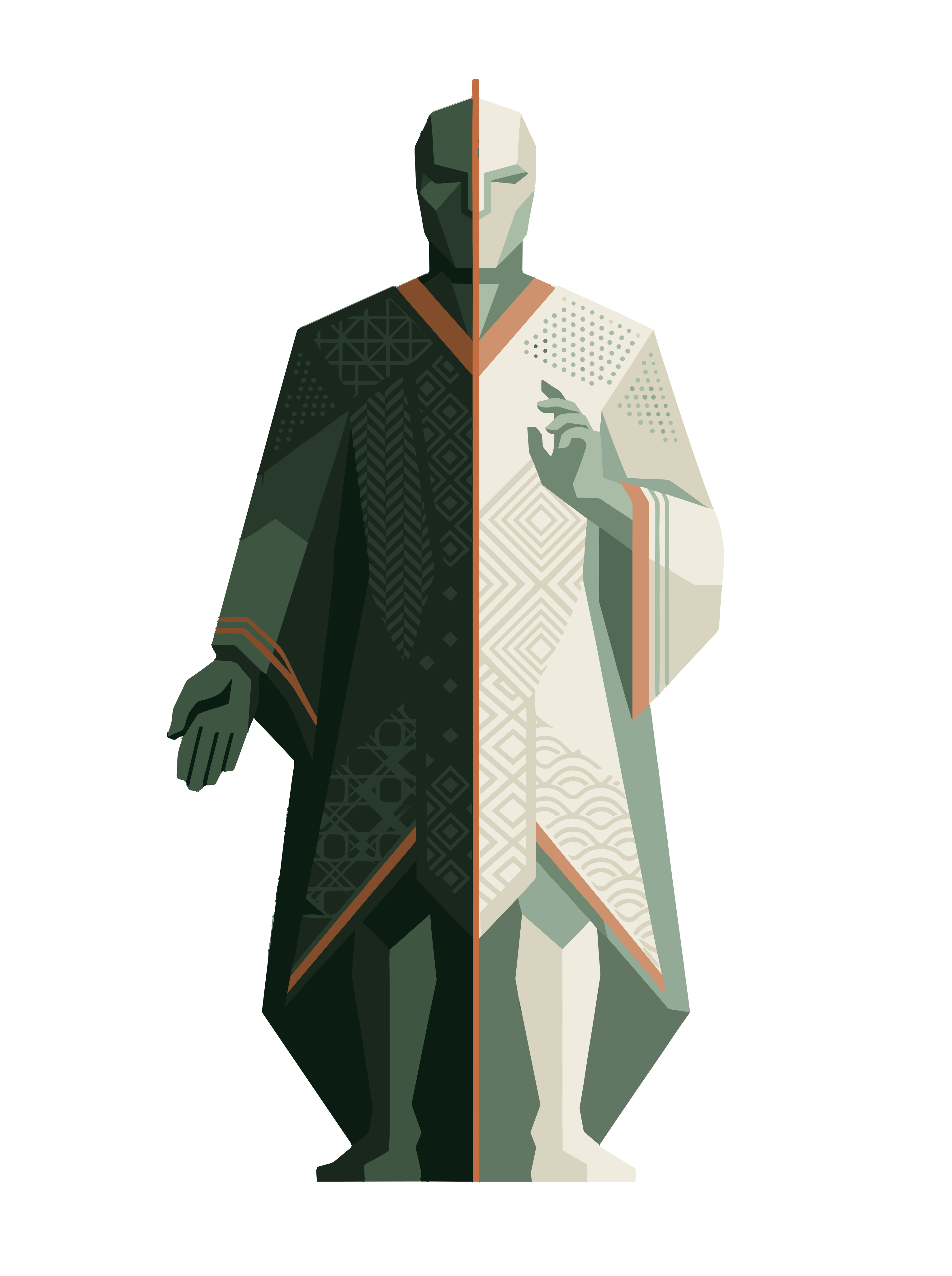
You've been asked 'but what are you, really?' more times than you can count. Dom or sub? Top or bottom? In a world that insists you pick a lane, your honest answer has always been 'both — and it depends.' You've probably worried that makes you indecisive. That you haven't done the work of figuring yourself out. That real Doms don't submit and real subs don't take charge. Here's the truth: you're not confused. You're a Switch. In the BDSM community, you'd be recognized as Versatile, Role-fluid, Power-fluid — someone who genuinely inhabits both sides of the power exchange, not as a compromise, but as a complete identity. When you dominate, it's not roleplay. When you submit, it's not settling. You contain the full spectrum of D/s, and which side surfaces depends on the partner, the chemistry, the moment. You didn't fail to choose. You chose all of it — and all of it is authentically you.
What separates you from the Alchemist — the other fluid archetype — is where your fluidity lives. The Alchemist is an explorer driven by curiosity; they want to try everything because it's new and fascinating. Your fluidity isn't about exploration — it's about identity. You don't experiment with dominance; you are dominant. You don't try out submission; you are submissive. Both completely, both genuinely, sometimes within the same evening. The Alchemist is still discovering what resonates. You already know — it all does, because all of it is genuinely who you are.
People outside D/s see you shift between leading and following and assume you're unstable or going through a phase. Even within BDSM communities, switches sometimes face skepticism — treated as less committed than someone who is 'fully' dominant or 'fully' submissive. But anyone who's been in a dynamic with you knows the truth: your switching isn't indecision. It takes more self-knowledge to inhabit every role authentically than to settle into one. You're not half a Dom and half a sub. You're a complete Dom and a complete sub who happens to be one person.
You've noticed that the role you take depends entirely on the person in front of you — not as a performance, but as a genuine response. With one partner your whole body says 'I've got this.' With another, something in you softens and says 'take me.'
Someone asked you 'but what are you really?' and you realized there is no 'really.' Every version is equally real.
You've felt a partner's energy shift and, without thinking, shifted to match — not performing, but genuinely becoming what the dynamic needed.
You've topped someone with full authority — setting the scene, holding control, guiding every moment — and later that same week, you were on your knees for someone else, surrendering completely, feeling the same bone-deep rightness. Both times, anyone watching would have sworn they were seeing 'the real you.' They were. Both times.
A partner has said 'I need to know what you are' or 'I can't be with someone who keeps changing.' It hit you hard — not because they were wrong to want clarity, but because you do have clarity. You are this. All of it. The problem was never that you're unclear. The problem is that their definition of clarity only has room for one answer.
People who need categories will struggle with you. Some will call you indecisive, confused, or 'not serious' about the dynamic. What they can't see is that your fluidity requires more self-knowledge than any fixed identity. You have to understand all the roles — not just play at them, but genuinely embody them — and you have to know which one is called for in any given moment. That's not confusion. That's mastery.
You're driven by connection over identity. While others organize their desire around 'I am dominant' or 'I am submissive,' you organize yours around 'what does this connection need?' Your identity in a dynamic is relational — it emerges from the space between you and your partner. You're not shapeless; you're responsive. You don't lack a center; your center is adaptability itself.
You need a partner who loves all your versions — not just the one that's convenient for their own identity. You need someone who doesn't feel threatened when you shift, who doesn't try to pin you to one expression of desire. And you need to be seen as whole. The worst thing someone can say to you is 'I wish you were always like this' — because it means they only love part of you. You need someone who loves the entirety.
You can meet anyone where they are. Your adaptability means every partner gets the dynamic they need, not a fixed performance.
You understand power exchange from every angle. Having inhabited both sides gives you an insight that fixed-role people may never develop.
You challenge the rigidity of categories and help partners discover their own hidden range.
You express love by showing up as whatever your partner needs — protector, playmate, surrender, challenge. Every expression is genuine; none is performed. What you need in return is the freedom to be all of yourself without being asked to choose. You need a partner who finds your range exciting rather than confusing, who says 'show me another side' instead of 'pick one.'
Trust for you is about safety across all expressions. You trust someone who holds you with equal care whether you're leading or following, commanding or surrendering. Someone who doesn't prefer one version over another, or who loves your submission but is uncomfortable with your dominance, will eventually lose your trust — because they're asking you to fragment yourself.
Your responsiveness can become self-erasure if you're not careful. If you're always becoming what the other person needs, who are you when no one is watching? You might also struggle to find partners — many people want someone who fills a specific, consistent role, and your 'all of the above' can feel unsettling to people who need that predictability. But here's the harder question: is your switching always genuine fluidity, or is it sometimes escape? When a dynamic deepens to the point where staying in one role would require real, uncomfortable vulnerability — do you switch? Not because the energy called for it, but because moving is easier than staying still? Genuine fluidity means being able to hold one mode long enough for it to crack you open. If you're always in motion, ask yourself honestly: are you flowing — or avoiding?
Under stress, your fluidity can become instability. Instead of smooth, intentional transitions between energies, you might oscillate rapidly, confusing both yourself and your partner. You might also default to whatever role feels safest rather than what's authentic, using your adaptability as a survival mechanism rather than a genuine expression. At your most stressed, you might wonder if the critics are right — if your fluidity is just indecision — and that self-doubt can be paralyzing.
Your invitation is to find your still point. Not to pick a side, but to discover what stays constant across all your expressions. What remains true about you whether you're commanding or surrendering? That consistency is your center — not a fixed role, but a fixed self that expresses through every role. When you know who you are independent of the dynamic, your switching stops being reactive and starts being truly chosen. That's the difference between fluidity and drift.
At its best, your dynamic has no default. Monday you're gentle and guiding; Thursday you're being held and guided. The transition feels effortless because neither of you is performing — you're both responding to what the moment actually needs. There's no awkward negotiation of 'who are you tonight?' because you've built enough trust that the shift happens naturally. Your partner doesn't need you to be consistent. They need you to be real. And you are — every time, in every direction. That's what makes it work: not predictability, but presence.
That you're a switch who hasn't decided yet. You have decided — you've decided to be all of it.
That your fluidity means your submission or dominance is less genuine. When you submit, you submit fully. When you dominate, you dominate fully. The authenticity isn't diluted by range.
That you need to 'figure yourself out.' You already have. The answer is just more expansive than a single label.
“I'm a Switch — and I mean that seriously. When I top, I need you to trust my authority completely. When I bottom, I need you to hold me just as fully. I want us to build a dynamic that has room for all of it. Can we talk about what that looks like?”
“I want to explore power exchange in both directions with you — maybe even within the same scene. That takes a lot of trust on both sides. How do you feel about fluid dynamics?”
“I want to tell you something about how I experience intimacy. Sometimes I need to be the one in charge — planning, leading, holding. And sometimes I need to be the one who lets go completely and trusts you to carry everything. Both are real parts of me, and I need you to love both.”
“When I take care of you, that's genuinely me. And when I need you to take care of me, that's just as genuinely me. I'm not contradicting myself — I'm showing you all of who I am.”